Designed by a nine-specialist panel, attacked by an independent reviewer, then
revised. Every number here is a delta from something measured in week 1.
THE 50 PROGRAMME (v3, adaptive)
Victor del Rosal. 17 August 2026 to 16 February 2027. 26 weeks. Target: 16 February 2027.
v2 is archived at data/programme-v2-archive.md. Nothing in it is lost; the reasoning moved to PART TWO.
---
PART ONE: THE PLAN
1. THE ONE PARAGRAPH
Four versions of the same week, sized 8+, 4.5, 2.0 and under 2.0 hours. On Sunday you count the hours in next week's calendar, write one letter, and that letter is the week. A declared MAINTENANCE week is a completed week, not a failed FULL week. Sessions that were never declared cannot be missed, so nothing is ever made up, nothing is doubled, and no decision is made at 06:15. The drop order is written in advance, the re-entry ladder is written in advance, and the two dates that are certain (a tournament, Christmas) are declared 30 days out. Six things never drop in any tier. Everything else is negotiable in the right week. The target does not move: 16 February 2027, visibly strong, fully healthy.
---
2. THE FOUR WEEKS
| Tier | Hours available | Sessions | Hard sets | Preserves | Choose it when |
|---|
| T1 FULL | 8.0+ | 9 (4 lift, 1 4x4, 3 Zone 2, 1 hitting) | 67 (58 in Block C) | Builds. Everything. | Normal home week, no travel, no fixture inside 7 days |
| T2 COMPRESSED | 4.5 to 7.9 | 6 (4 lift, 1 4x4, 1 hitting) | 40 | Strength, side delts, back, most size | Teaching block, in-season week, day 3+ abroad, week after a tournament |
| T3 MINIMUM | 2.0 to 4.4 | 2 lift, 45 min each | 20 | Strength and nearly all size for 3 to 4 weeks | Marking deadline, tournament week, sick child, 2 hours exist |
| T4 MAINTENANCE | under 2.0 | 2 lift, 20 min each | 9 | Movement patterns and the streak. Not a build dose. | Hotel, flight days, Christmas, first 48 hours in Mexico |
| T0 REST | any | 0 | 0 | Nothing, by design | Fever, illness, any section 8 escalation flag |
T4 is a continuity dose, not a maintenance dose. Its job is that the log never reads zero. Steps floor: 7,000 a day at every tier. That replaces the old 150-minute Zone 2 promise, which a tournament plus an 11-hour flight breaks.
---
3. WHICH WEEK AM I IN
Sunday, 11:00, 3 minutes, inside the existing 10-minute review. Run in order, first match wins.
- Any day next week with 2 or more competitive games? → T3, and apply rule 6.1.
- Any flight of 6 hours or more? → the trip runs on rule 6.2, not on a weekly tier.
- Is it 21 Dec to 3 Jan? → T4, both weeks, already declared on 1 December.
- Otherwise: count the hours genuinely free for training in the 7 days ahead, from the actual calendar. 8.0+ → T1. 4.5 to 7.9 → T2. 2.0 to 4.4 → T3. Under 2.0 → T4.
- Were 2 or more of the last 3 weeks below T1? → drop one tier below what step 4 gave you, for 1 week only.
Write the letter at the top of the week's log. The tier may be dropped once, on Wednesday only. It is never raised mid-week.
Arbitration. Where the tier declaration and the volume gate (6.10) disagree, the gate sets the number and the tier sets the sessions. Declare the letter, run that tier's session layout, and take the hard-set count from the gate.
Season override. Between the first and last outdoor fixture, the ceiling is T2 even if 10 hours exist: 3 lifting sessions, 45 to 52 hard sets, no Monday sprint block, no Saturday med ball. The games supply both. From the week after the last fixture to 16 February there is no fixture, so run T1 at 67 sets and stay there. That fixture-free window is the asset the calendar hands him.
---
4. THE SESSIONS
Universal rules: compounds stop at 1 to 2 reps in reserve, isolation last sets at 0 to 1. Eccentric 3 seconds except the heavy hinge and the chin (2 seconds). Rest 3 min main, 2 min backoff, 60 to 90 s isolation. Add load in 1.25kg per side only when every set hits the top of the range at the prescribed RIR. A unilateral exercise counts as 1 hard set for both sides. Warm-up ramps, external rotations, hangs and carries are not counted.
Warm-up ramp, 6 sets, in front of the first heavy lift of every session: bar, 40, 55, 70, 80, 88 percent. Compresses to 3 sets at T4. Never to zero.
Equipment split. Weeks 1 to 15 (17 Aug to 29 Nov) are home only: 2 adjustable dumbbells to 24kg per hand, bands, door anchor, no bench, no bar, no rack, no pull-up bar, no cable. Weeks 16 to 26 (30 Nov on) are gym. Every session below prints both columns. Substitutions are permanent, not apologetic.
4.1 T1 FULL, 9 sessions, 590 minutes, 67 hard sets
Mon Power block + Upper A 90. Tue Lower A 85. Wed 4x4 bike 40. Thu Upper B 70 + Zone 2 50. Fri Lower B 80. Sat med ball + 60 swings 75 + Zone 2 50. Sun Zone 2 50. Mobility 6 min daily. All hard efforts start 07:05 and finish by 08:45.
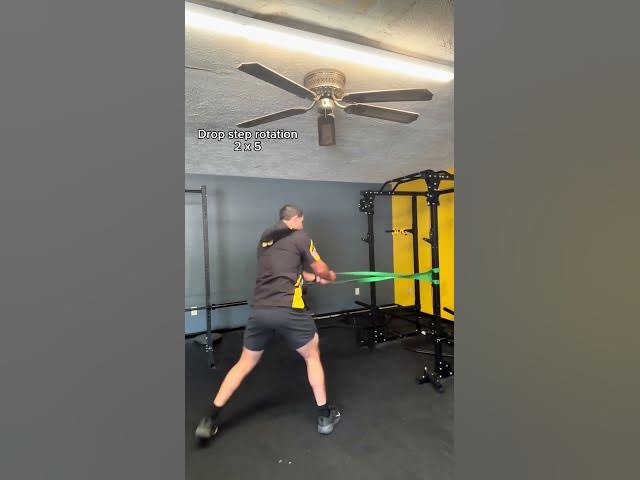
Power block (Mon, 20 min, before lifting): 8 min prep (bike 3, leg swings, A-skips, 3 build-ups at 60/75/90). 6 x 20m accelerations from a two-point stance, walk-back, 90s. Rotational med ball scoop toss to a wall 3 x 5 per side, 4kg, maximum intent, never catch the rebound. From 1 Nov to 28 Feb the sprints move indoors, warm-up extended to 12 min; if no indoor surface, 6 x 8s bike sprints from a rolling start, 90s between, and that is a downgrade.
MONDAY, Upper A, 18 hard sets
| Exercise (gym, wk 16+) | Home, wk 1 to 15 | Sets x reps | Hard | Load |
|---|
| Seated dumbbell lateral raise | same, 2 x up to 24kg | 4 x 12-15 | 4 | 1s up, pause, 3s down, last set 0-1 RIR |
| Flat barbell bench press | Floor press 2 x 24kg, or feet-elevated push-up + 3s down | 3 x 6-10 | 3 | 1-2 RIR. The tested lift |
| Strict overhead press, 1 top set of 5 at RPE 8 then 3 x 6 at 85% | Standing dumbbell press, same scheme | 4 total | 4 | Autoregulated |
| Weighted dip or deep-stretch cable fly | Deficit push-up between chairs, 3s stretch | 2 x 10-15 | 2 | 1-2 RIR |
| Face pull | Band pull-apart, door anchor | 2 x 15-20 | 2 | 0-1 RIR |
| Overhead cable triceps extension | Overhead dumbbell extension | 3 x 12-15 | 3 | 0-1 RIR |
| Cable external rotation at 90 deg | Band external rotation | 3 x 12 | not counted | 3s eccentric |
TUESDAY, Lower A, squat pattern, 16 hard sets. Opener: 2 x 3 unloaded countermovement jumps, submaximal, priming only.
| Exercise (gym) | Home | Sets x reps | Hard | Load |
|---|
| Back squat, 1 top set of 3-5 at RPE 8 then 3 x 5 at 85% | Goblet squat 24kg, or rear-foot-elevated split squat 2 x 24kg | 4 total | 4 | Autoregulated |
| Bulgarian split squat or leg press | Bulgarian split squat, 2 x 24kg | 3 x 8-12 | 3 | 1-2 RIR |
| Romanian deadlift | Dumbbell RDL 2 x 24kg, 5s eccentric | 3 x 8 | 3 | 1-2 RIR |
| Nordic hamstring curl or slider leg curl | Slider or towel leg curl | 2 x 5 | 2 | 4s eccentric |
| Leg extension 3s/1s/3s, or Spanish squat | Spanish squat, heavy band round a door anchor at knee height | 2 x 8 | 2 | Tendon block, RPE 8 |
| Lying neck extension + lateral flexion | Hand-resisted, same reps | 2 x 15-20 | 2 | Start 2.5kg, +1.25kg when 20 is easy |
| Farmer's carry 3 x 40m | Suitcase carry 2 x 24kg, add 15m every 2nd week | not counted | | Gym: +2kg/hand every 2nd week, cap 60kg |
WEDNESDAY, 4x4, 40 min. 10 min bike warm-up. 4 rounds of 4 min at 90 to 95% max HR, 3 min easy between. 5 min cooldown. Round 1 by effort (RPE 8-9), rounds 2 to 4 by heart rate. Log average watts. If round 4 is more than 5% below round 1, the opening was too hard. Bike only, never evening. Weeks 1, 9, 17 and 26 it is replaced by the 12-minute bike time trial.
THURSDAY, Upper B, pull and rear delts, 16 hard sets
| Exercise (gym) | Home | Sets x reps | Hard | Load |
|---|
| Cable lateral raise from behind the hip | Band lateral raise, door anchor | 4 x 15-20 | 4 | 3s eccentric, last set 0-1 RIR |
| Weighted chin-up | Heavy band pulldown from door anchor, 3s down | 3 x 5-8 | 3 | 1-2 RIR |
| Chest-supported or seal row | One-arm dumbbell row 24kg, 1s hold | 3 x 8-12 | 3 | 1s hold at contraction |
| Straight-arm pulldown or pullover | Band straight-arm pulldown | 2 x 12-15 | 2 | Full stretch |
| Reverse pec-deck | Band reverse fly | 2 x 15-20 | 2 | 0-1 RIR |
| Incline dumbbell curl, 3s eccentric | same | 2 x 10-12 | 2 | 0-1 RIR |
| Dead hang 2 x 30-45s | Not available until wk 16. Substitute: 2 x 45s suitcase hold 24kg | not counted | | +5kg belt when 45s is easy |
| Bodyweight chin to failure, monthly | Deferred to week 16 | 1 set | not counted | Rep-standard test |
Evening: Zone 2, 50 min, bike or incline walk, full sentences throughout.
FRIDAY, Lower B, hinge pattern, 17 hard sets
| Exercise (gym) | Home | Sets x reps | Hard | Load |
|---|
| Trap-bar deadlift, 1 top set of 3 at RPE 8 then 2 x 5 at 85% | Dumbbell suitcase RDL 2 x 24kg, 5s eccentric | 3 total | 3 | Autoregulated |
| Hip thrust 3s/1s/3s | Hip thrust off the sofa edge, 24kg on the hips | 3 x 10 | 3 | 1-2 RIR |
| Lean-away single-arm cable lateral raise | Lean-away dumbbell lateral raise | 3 x 12-15 | 3 | 0-1 RIR last set |
| Copenhagen adductor plank | same | 2 x 8/side | 2 | Short lever to wk 8, then long |
| Wrist flexion + reverse wrist curl superset | same, dumbbells | 2 x 12-15 each | 2 | 0-1 RIR |
| Neck flexion | Hand-resisted | 2 x 15-20 | 2 | Slow, no jerking |
| Single-leg heel raise off a step 3s/3s | same | 2 x 8 | 2 | Achilles block, also the capacity test |
| Farmer's carry 3 x 40m | Suitcase carry, as Tuesday | not counted | | |
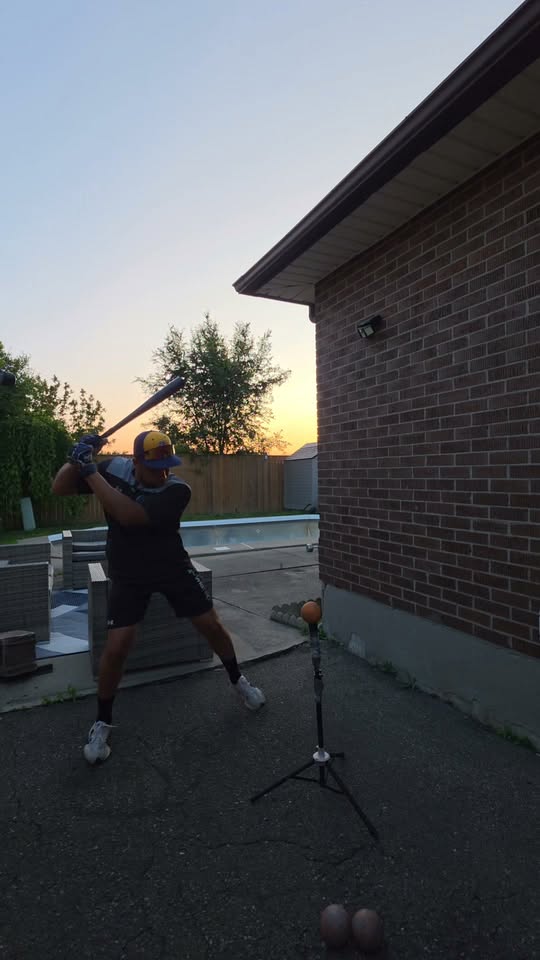
SATURDAY. Step-behind rotational throw 4 x 5/side (4kg) and half-kneeling shotput throw 3 x 5/side (3kg), 60s between, every throw at maximum intent. Then 60 swings: 20 off a mid tee on the one fix of the week, 25 alternating high and low tee, 15 free swings at full intent into a net. Partner present: the middle 25 become bucket toss. One fix per session, film every 4th. If the swings go lazy, stop at 40. Plus 2 sets ab wheel. Evening Zone 2 50 min.
SUNDAY. No lifting, no sprinting, no cage. Zone 2 50 min. Mobility. 10-minute review: tier declaration, 7-day weight, 7-day BP, RHR vs 14-day baseline, volume gate.
Weekly tally, T1: side delts 11, hamstrings and glutes 11, quads 9, back 8, chest 5, arms 5, OHP 4, rear delts 4, neck 4, Copenhagen and heel raise 4, forearm 2. Total 67. Mon 18, Tue 16, Thu 16, Fri 17. Ceiling 70.
4.2 T2 COMPRESSED, 6 sessions, 350 minutes, 40 hard sets
| Slot | Minutes | Content | Hard |
|---|
| Mon Upper A | 60 | Lateral raise 3, bench/floor press top set + 1 backoff, OHP top set + 1, triceps 2 | 9 |
| Tue Lower A | 60 | Squat top set + 2, split squat 2, RDL 2, Nordic 2, neck 1 | 10 |
| Wed 4x4 | 25 | 3 rounds, not 4 | 0 |
| Thu Upper B | 60 | Lateral raise 3, chin or band pulldown 3, row 3, curl 2 | 11 |
| Fri Lower B | 60 | Hinge top set + 1, hip thrust 2, lateral raise 3, Copenhagen 1, heel raise 1, neck 1 | 10 |
| Sat | 45 | Throws + 40 swings | 0 |
Zero Zone 2 slots; the 7,000-step floor covers it. Side delts fall from 11 to 9 sets: last accessory trimmed, first restored. In a hotel room with no equipment, T2 is run as HOTEL T2 (4.6), 3 sessions of 45 minutes and 27 hard sets. That is the abroad version of this tier and it is a complete T2 week, not a damaged one.
4.3 T3 MINIMUM, 2 sessions, 90 minutes, 20 hard sets
Session A, 45 min: ramp, press top set + 2 backoffs (3), squat or split squat top set + 2 (3), lateral raise 3, neck 1. 10 sets. Session B, 45 min: ramp, chin or row top set + 2 (3), hinge top set + 2 (3), lateral raise 3, heel raise 1. 10 sets. Book both at 06:15 as calendar events with the same status as a lecture. Loads unchanged from the last normal week. Stop at set 20 even if time remains. No conditioning, no isolation arms, no hitting. Mobility 6 min daily, 7,000 steps. Log 3 numbers only that week: sessions done (0, 1 or 2), protein hit yes/no, average steps.
4.4 T4 MAINTENANCE, 2 sessions, 40 minutes, 9 hard sets
Session A, 20 min: 3-set ramp, 1 heavy press set at RPE 8, 1 heavy squat-pattern set at RPE 8, lateral raise 2. 4 sets. Session B, 20 min: 3-set ramp, 1 heavy pull set at RPE 8, 1 heavy hinge set at RPE 8, lateral raise 2, neck 1. 5 sets. Intensity holds at RPE 8, load holds, only volume collapses. Mobility 6 min daily, 7,000 steps.
HOTEL 32, the no-equipment version of T4 (32 min, 13 hard sets). Pack list, 380g, lives in the suitcase permanently: 1 heavy long loop band, 1 light long loop band, 1 mini band, 1 door anchor.
| # | Exercise | Sets x reps |
|---|
| 1 | Rear-foot-elevated split squat, back foot on the bed, heavy band under front foot over both shoulders | 3 x 12/leg |
| 2 | Band row, door anchor at chest height | 3 x 15 |
| 3 | Standing band overhead press, both feet on the band | 3 x 12 |
| 4 | Band RDL, 3s lowering | 3 x 15 |
| 5 | Decline push-up, feet on the bed | 2 to 2 RIR |
| 6 | Suitcase carry, the actual packed suitcase, 4 corridor lengths | 2 |
| 7 | Band pull-apart | 2 x 20, not counted |
Progress HOTEL 32 by tempo and range only, never by adding sets: 3s lowering, 1s pause on every band exercise.
4.5 Home progression ladder, weeks 1 to 15
Load is capped at 24kg per hand, so overload runs a fixed 6-rung ladder. Move up one rung only when the current one is exhausted. Rung 7 is load, and there is no rung 7 until week 16.
- Add 1 rep to every set, to the top of the range. 2. Add 1 set. 3. Slow the eccentric from 3s to 5s. 4. Go unilateral. 5. Add a band in series with the dumbbell. 6. Cut rest by 15s.
Week 16 is the first gym week: re-establish the 6-set ramp at conservative loads and test nothing until week 17.
4.6 HOTEL T2, the no-equipment T2, 3 sessions, 135 minutes, 27 hard sets
This is what "T2, day 3+ abroad" actually means. Same pack list as HOTEL 32 (380g: heavy long loop band, light long loop band, mini band, door anchor) plus the packed suitcase, which is the only load in the room. Run the band anchor protocol in Appendix G before the first rep of every session. Movements are drawn from HOTEL 32 and from the home column of 4.1; nothing here needs a gym, a bench or a bar.
Four heavy top sets live inside these three sessions, one per pattern, so floor item 5 holds abroad. Each is a single set at RPE 8 on the heavy band or the loaded suitcase, taken after the 3-set ramp, with the prescribed backoffs after it.
Session A, 45 min, press, 9 hard sets
| Exercise | Sets x reps | Hard |
|---|
| 3-set ramp, then standing band overhead press, both feet on the heavy band: 1 top set at RPE 8, then 2 x 12 | 3 total | 3 |
| Band lateral raise, door anchor low, 3s eccentric | 3 x 15-20 | 3 |
| Decline push-up, feet on the bed, 3s lowering | 3 to 2 RIR | 3 |
| Band pull-apart, band external rotation | 2 x 20, 2 x 15 | not counted |
Session B, 45 min, squat and hinge, 9 hard sets
| Exercise | Sets x reps | Hard |
|---|
| 3-set ramp, then rear-foot-elevated split squat, back foot on the bed, packed suitcase held: 1 top set at RPE 8, then 2 x 12/leg | 3 total | 3 |
| Band RDL, heavy band, 3s lowering: 1 top set at RPE 8, then 2 x 15 | 3 total | 3 |
| Slider or towel leg curl, 4s eccentric | 1 x 6 | 1 |
| Copenhagen adductor plank, short lever | 1 x 8/side | 1 |
| Lying neck extension, hand-resisted | 1 x 15-20 | 1 |
| Suitcase carry, the packed suitcase, 4 corridor lengths | 2 | not counted |
Session C, 45 min, pull, 9 hard sets
| Exercise | Sets x reps | Hard |
|---|
| 3-set ramp, then heavy band pulldown from a high door anchor, 3s down: 1 top set at RPE 8, then 2 x 8 | 3 total | 3 |
| Band lateral raise, door anchor low | 3 x 15-20 | 3 |
| Band row, door anchor at chest height, 1s hold | 2 x 15 | 2 |
| Band reverse fly | 1 x 15-20 | 1 |
Progress by tempo and range only, never by adding sets, exactly as HOTEL 32 does. No isolation arms and no conditioning: they are drop-order items 2 and 1, and they stay dropped abroad. Alongside: mobility 6 min daily, 7,000 steps, protein floor 150g met with whey in the bag and restaurant protein, and the floor's rotational exposure per the abroad clause in section 5.
---
5. THE DROP ORDER
When a week compresses, things leave in this exact sequence. Stop as soon as the week fits. Never renegotiated in the moment.
- Zone 2 slots, all 150 min (Thu, Sat, Sun). Two weeks to rebuild; the step floor covers the physiology.
- Isolation arms, forearms, ab wheel: Mon triceps 3, Thu curls 2, Fri wrist 2, Sat ab wheel 2.
- Second-tier accessories to 1 set, then 0: dip/fly, straight-arm pulldown, reverse fly, face pull, leg extension, carries.
- Backoff sets on the main lifts. Keep the RPE 8 top set, delete the 3 x 5 at 85%. This alone turns a 90-minute session into 50.
- Hitting: 60 swings down to 20 tee swings on the one fix of the week.
- The 4x4. It outranks every isolation set because it is the only VO2max lever.
- Session count: 5 lifting days to 4, then to 2 full-body.
- Hip thrust, Copenhagen, heel raise, neck to 1 set each.
- Saturday med ball, if the week contains a tournament (the games are the exposure).
THE FLOOR: six things that never drop, in any tier, any week
- The Sunday declaration, 5 min. No equipment, no energy, no health required, so there is no week in 26 where it can legitimately fail.
- Protein at or above 150g a day, 3 or more feeds of 40g+. Substitution not addition, so it costs 0 minutes; 2 scoops of whey in the bag is 88g.
- The wake anchor: within 45 min of the same LOCAL time, 7 days, re-anchored on arrival. At home that local time is 06:15. Cross zones and it becomes 06:15 destination time from the first morning after landing, which is what 6.2 already prescribes. Free, and it is the input every other prescription runs on.
- The mobility circuit, 6 minutes daily (90/90 hip switches, half-kneeling hip flexor, quadruped t-spine rotations, side-lying windmills, then 4 in / 6 out breathing). Run the list in that order and stop at 6 minutes; what is reached is the dose. Six minutes is the floor and the only mobility number in this document. Longer is a preference, never a floor. The only item on the calendar with zero recovery cost, and the first one everybody drops.
- Four heavy top sets a week at RPE 8, one each in press, pull, squat, hinge, with the 6-set ramp in front of the first. Intensity is what retains adaptation when volume collapses; 20 minutes if that is all there is.
- One rotational intent exposure every 7 days: 3 x 5 med ball scoop tosses per side at 4kg, or 20 tee swings at full intent. Twenty, not sixty. A tournament week satisfies this automatically. Abroad, where neither a tee nor a wall for a 4kg ball exists, this downgrades to 20 full-intent shadow swings, executable in any room, and it is still forbidden inside the 48 hours after a sector over 6 hours. Pack a 4kg med ball or a swing trainer if the trip has hold luggage and the item survives the weight limit; the shadow swings are the version that never fails.
Steps floor of 7,000 a day sits alongside these and is met by terminals, dugouts, commutes and family walks.
---
6. WHEN IT GOES WRONG
Arbitration, read before any branch below. When two ladders in this section both apply, run the longer one and count from the later event. That single line settles a tournament followed by a flight, a Christmas fortnight spent in Mexico, and the 5 January return. There is no judgement call: count the days in each ladder, take the one with more days, and start it from whichever event happened last.
6.0 One session missed
Delete it. Do not make it up, do not double up, do not add sets to the next session. If 2 or more days remain in the week, the next session may move forward by exactly 1 day, once. Otherwise the week is one session shorter and that is a completed week. Log MISSED with a 3-word reason. Cumulative missed-session counts are not tracked anywhere in this document, by design.
If a second session goes by end of Wednesday, drop one tier immediately and run the rest of the week as that tier.
6.1 Tournament weekend (2 or more competitive games in a day)
Counted backwards from first pitch, not forwards from Monday. Declare T3 on the Sunday before.
| Point | Action |
|---|
| T-7 to T-4 | Keep the sessions, cut hard sets 67 to 45 by deleting every backoff and every isolation below 2 sets. Top-set loads unchanged. |
| T-5 | Last heavy lower-body session of the block. No lower-body session after it. No 4x4 inside T-5. |
| T-4 | No sprints inside this point. |
| T-3 | Last lift: upper only, 8 hard sets at 3 RIR, no 3s eccentrics, 35 min. |
| T-2 | 6-min mobility + 20 tee swings at 70%. Nothing else. |
| T-1 | 30-min walk, 6-min mobility, 15 intent swings off a tee, 3 x 5 med ball scoop tosses/side at 4kg (skip the throws if T-1 is a travel day). |
| Game days | No lifting, no sprints, no 4x4, no Zone 2. Mobility 6 min before leaving, 6 min again that night. Between games: walk, never sit more than 40 min. Cap non-game swings at 40 for the day. Feed every 3 hours, protein floor 150g, 500 to 700mg sodium per litre in heat. Second game day: add 20 calf pumps and a 10-min walk before bed. |
Re-entry, counted from the final out, not the following Monday. Day 1: 45-min Zone 2 walk + 6-min mobility. Day 2: upper only, top sets only, 85% of last load, 10 hard sets. Day 3: Zone 2 50 min + mobility. Day 4: lower, top sets only, 80% of last load, no Nordics, no jumps, 10 hard sets. Day 5: normal upper returns. Power block, sprints and med ball stay deleted for all 5 days. 4x4 returns day 6. The week logs as 45 achieved, not 22 missed. Cost per tournament: about 22 hard sets. Not made up.
Two tournaments within 14 days. Do not run two tapers. Treat the 14 days as one competition block: exactly 2 sessions between them, both upper-dominant, 10 hard sets each, top sets only at 85%. Zero lower-body lifting, zero sprints, zero Nordics, zero 4x4 across the whole 14 days. T-2 and T-1 rules still apply to the second tournament. Then 1 deload week at 30 hard sets, full volume in week 2. Cost about 90 sets across 3 weeks. See it coming 6 weeks out.
Something hurts at a tournament (hamstring twinge, low-back lock, shoulder pain on the throw, or 3 consecutive at-bats where the swing feels late and heavy). Drop in this order, no improvising: 1. all between-game and on-deck free swings, keep game at-bats. 2. base-running intensity to 80% on anything not a live play. 3. the throw: move to the shortest-throw position available. 4. the game. Then 7 days: no lifting of the affected pattern, mobility only. Pain at rest, swelling, calf tenderness, chest pain or breathlessness is a same-day clinician call, not wait-and-see (section 8).
6.2 Long-haul flight, 6 hours or more
Price the trip at booking, not the week of. Spain (1 zone, 3h): 0 lost days. Mexico westbound (6 to 7 zones, 10 to 11h): 3 lost days. Mexico eastbound home: 4 lost days. Move the block's heaviest session to the 4 days before departure, and pull the nearest booked deload forward onto the trip.
Flight day: no lifting either direction, and none in the 12 hours before takeoff. 20-min walk before leaving, 15-min terminal walk. In the air: aisle seat booked at purchase, 250ml water per hour, 0 alcohol, stand and walk 5 min every 60 min (set 8 alarms before takeoff), 20 seated calf pumps every 30 min. 3 protein feeds of 40g+ brought aboard. Watch set to destination time at the gate; eat on destination time from then.
Landing (westbound, 6 to 7 zones): 30 min outdoor daylight within 2 hours, walk 40 to 60 min total. No nap over 25 min, none after 16:00 local. Lights out 22:15 local whatever the body says. No sprinting, jumping or maximal-intent throwing for 48 hours after any sector over 6 hours.
Re-entry ladder, westbound. Day 1: walk 45 min + mobility, 0 hard sets. Day 2: HOTEL 32 at RPE 6-7, 8 hard sets. Day 3: HOTEL 32 in full, 13 hard sets, 1 to 2 RIR. Day 5 on: full quality, sprinting and maximal throwing permitted. Eastbound home: add 1 day to every rung (first hard session day 4). Two override gates: resting heart rate more than 8 bpm above the 7-day average, or under 6 hours sleep, drops the day one rung. If a flight lands inside T-3 of a fixture: delete both travel sessions, mobility plus 15 tee swings only. A 10-day Mexico trip is T4 days 1 to 2 (HOTEL 32), T2 days 3 to 8 (HOTEL T2, 4.6), T4 days 9 to 10. That is a completed trip.
6.3 Marking deadline or teaching block, 2 hours exist
Declare T3 on the Sunday. Spend the 120 minutes in this fixed order and stop when the budget runs out: 1) two 45-min sessions from 4.3, both at 06:15, before email. 2) 6 min mobility daily. 3) walking, which is not counted against the 120. Do not add a third lift. Do not extend a session because it felt good. Nothing is made up the following week. Two of these back to back is fine. Three in a row means the block dates move, not the sessions.
6.4 Sick child, or a week that collapsed with no warning
Same as 6.3, T3 or T4, declared as late as Wednesday. If the week is already past Wednesday, run T4 on whatever days remain and declare the following week one tier below what the calendar allows.
6.5 Short sleep
One night under 6 hours: keep every load, cut that day's hard sets by one third. Three nights under 6.5 in a rolling 7: the whole week drops one tier, calories go to maintenance 3,100 regardless of block, protein goes UP to 190g. No extra caffeine beyond the standing 250mg at 06:30. Wake time holds; recover sleep at the front end, never by sleeping in.
6.6 Weeks missed
The honest detraining numbers are in Appendix D, in full. The one line that matters at 06:15: a gap of 14 days or fewer costs no reliably measurable strength and no measurable size, so nothing below is a rescue.
Re-entry ladder. Gap of 8 days or fewer: return at 100%, same tier, no cap. 1 week (9 to 14 days): same tier, same loads, first session capped at 90% of the last top set, add nothing; the calendar shifts forward 7 days. 2 weeks: return at T2, loads 90%, 2 sessions week 1, 4 sessions week 2, full tier from week 3. 4 weeks or more: RETURN BLOCK, 3 fixed weeks at 70% of the last recorded top set, RPE capped at 7, no sets to failure, no new exercises, no conditioning above Zone 2. Reassess at the start of week 4.
In all cases delete the missed weeks from the calendar rather than compressing what remains. The block that absorbs the loss is named in advance: Block B accumulation, never the final 4 weeks before 16 February.
6.7 Christmas, 21 Dec to 3 Jan
Declared T4 in ink on 1 December, labelled PLANNED. 2 sessions of 20 minutes a week at 80% of December loads, 7,000 steps daily (the floor number, the same one used everywhere else in this document), protein 190g held, calories at maintenance 3,100 (the Block C deficit is suspended), alcohol up to 4 drinks across the fortnight and none in the 3 hours before bed. Mobility runs all 14 days including 25 December. No weigh-ins between 20 December and 4 January. Return 5 January at T2, first heavy top set at RPE 7, full Block C calories on day one. No ramp, no penance week, no compensatory deficit.
6.8 The thought "I have fallen too far behind for this to work"
Also fires on: opening this document to rewrite it, comparing the current week against week 1, or counting total missed sessions. Two actions, in order. 1) Do the 6-minute mobility circuit now, today. 2) Write one line in the log. Then a hard prohibition: do not redesign, reschedule or rewrite this programme while behind. Edits happen only on a Sunday, only when the previous week hit its declared tier, and only one edit at a time.
6.9 A compressed week lands inside the Block C deficit
Suspend the deficit for that week: 3,100 kcal, protein 190g, resume the following Monday with no attempt to recoup. Never run a deficit week at fewer than 12 hard sets. Two consecutive compressed weeks pause Block C and the timeline absorbs it. 81.5kg with the muscle beats 81.0kg without it.
6.10 The Sunday volume gate
Run in order, first match wins.
- Fewer than 60% of prescribed hard sets performed in the last 7 days: prescribe the lesser of the declared tier's set count and last week's actual plus 30%, with a floor of the tier below the declared one. So a T1 week after two weeks at zero is not zero, it is T2's 40. A T1 week after a Mexico return of 10 actual sets is 40 (T2, the floor), not 13. Branch 0 can only ever slow the climb by one tier; it can never stop it.
- Any red morning in the last 7 days, or weekly session-RPE load above 1.3 x the 4-week mean, or heel-raise or hang capacity down more than 10% from the 4-week best: cut 30% of hard sets.
- Any lift whose top-set load dropped 2 sessions running: hold sets flat, add 250 kcal a day.
- Two clean weeks where every set hit the top of its range at the prescribed RIR: add 2 hard sets, capped at 70. Arms get them first.
- Otherwise: repeat the block's prescribed number.
An unplanned low week absorbs the nearest booked deload: delete it and move the next one out. Never run a booked deload in the week after a forced light week. Booked deloads: weeks 5, 10, 15, 20. Block D's taper is the fifth.
Morning gate, 5 min in bed. It runs on 7-day rolling means against a 60-day baseline. Until 60 days of HRV and RHR exist, log the numbers and do not act on them (Appendix P): amber and red fire on sleep hours and fever only, and branch 1's red-morning clause does not fire. Building the baseline is the whole job for the first 60 days. Green: run it as written. Amber (7-day HRV more than 1 SD down, or RHR up 4 to 6 bpm, or under 6 hours sleep): same exercises, same loads, cut working sets by one third. Red (RHR up 7+ bpm two mornings running, or HRV 2 SD down, or fever): T0, 30 min Zone 2, bed 45 minutes early. Amber and red days count their actual sets.
6.11 The tissue check, and the 3/10 tendon rule
The 3/10 tendon rule. Any localised tendon pain above 3/10 still present 24 hours after a session means that site drops to isometrics for a week. Soreness that settles inside a day is adaptation; soreness worse the next morning is accumulation. This sits below the escalation rule in section 8, never above it: anything on that list is a same-day clinician call regardless of what this rule says.
The four signals, logged Monday and Friday in the same sheet as everything else. Gate 6.10 branch 1 consumes two of them, so they are measurements, not observations.
- Minutes of morning stiffness in the worst joint.
- Single-leg heel raises to failure per side. Friday's set doubles as the test.
- Grip: dead-hang time to failure, once a fortnight. Grip is the bottleneck tissue in this programme (8 carry sets, 2 hangs and 8 pulling sets a week). There is no pull-up bar until week 16, so weeks 1 to 15 use the 45-second suitcase hold at 24kg per hand from Thursday's session as the tracked capacity number instead. Pick one on day one and never switch mid-programme; that is the number branch 1's "hang capacity down more than 10% from the 4-week best" reads until the bar exists.
- Session RPE times minutes, summed for the week. That is branch 1's session-RPE load.
---
7. THE NUMBERS
Two baselines, because the equipment changes at week 16. Barbell deltas are 11-week deltas measured from week 16, not 26-week deltas. Every strength number comes from an RPE 8 triple. No true 1RM test, ever. Estimated 1RM = load / (1.0278 - 0.0278 x r).
The three numbers to hold in your head.
- Half the weeks at T2 costs about 20% of total volume and lands at roughly 80% of the February deltas, spent almost entirely on arms and conditioning. That is the number that stops both the panic and the fantasy. It is also close to the design's expected case, because the season override forces T2 for the whole outdoor season.
- The February barbell numbers will overstate the strength gain. The only measured barbell window is 11 weeks, and 8 of those 11 sit inside the Block C deficit. Much of the delta is motor learning on a lift untrained for 15 weeks. That is not a problem; it is just not strength.
- The February metric to watch is the shoulder-to-waist ratio, because that is what the tier system protects and it is the one that survives compression.
The two baseline and target tables (week 1 home, week 16 gym, plus silhouette and conditioning) live in Appendix N. They are filled in four times in 26 weeks, not at 06:15.
Blocks and calories
| Block | Weeks | Dates | Sets (T1) | Calories |
|---|
| A RAMP | 1 to 5 | 17 Aug to 20 Sep | 52, 56, 60, 64, deload 32 | 3,100 flat |
| B BUILD | 6 to 15 | 21 Sep to 29 Nov | 67, deloads wk 10 and 15 | 3,500 lifting days, 3,150 other |
| C REVEAL | 16 to 24 | 30 Nov to 31 Jan | 58, deload wk 20, Christmas per 6.7 | 2,800 lifting days, 2,400 other |
| D SHARPEN | 25 to 26 | 1 to 16 Feb | 40 then 27, loads held | 3,100 flat |
Protein 190g target, 150g floor, 4 feeds of 45 to 48g at 07:00, 12:30, 17:00, 20:00. Hard floor: no day below 2,400 kcal. Fat never below 0.85 g/kg (about 70g). Last hard session Tuesday 10 February; retest 8 to 12 February. Full meal options, macro tables, hydration and the sweat test live in data/diet.md. Alcohol outside Christmas, the sleep hygiene rules and the 60-day baseline requirement are in Appendix P.
Suspended pending a clinician answer (section 8): sauna and hot-water immersion, high-dose fish oil, any vitamin K2 tablet. Until answered, none of the three.
---
8. MEDICAL
THE ESCALATION RULE, which overrides every training decision in this document
New or worsening breathlessness, chest pain (particularly on inspiration), coughing blood, unilateral calf pain or swelling, resting heart rate 15 bpm above baseline for more than 48 hours, sudden unexplained tachycardia, fainting, unusual or prolonged bleeding, an expanding bruise, or blood in urine or stool: same-day medical care, immediately. Not a deload decision, not an overtraining conversation, not a note in the log.
The thirteen clinician questions live in Appendix O, to be taken to one appointment before the first heavy week and before the first long-haul flight of the block. Nothing there is a directive about medication; every item is a question for the treating clinician.
Labs weeks 1, 13, 25. Fasted 12 hours, drawn 08:00 to 09:00 Monday, 48 hours clear of resistance training, 72 hours clear of alcohol. Panel and target values in Appendix G.
---
9. WATCH THIS
The clip library is the support layer. 60 kept clips of 113 in data/classified.json; 110 source items in data/lean.json. One clip, one cue, one set against that cue, log the index. Never more than 1 cue per session. Foundation-level clips in Blocks A and B, refinement in C and D, advanced only after a fix has held for 2 sessions. Where a clip cue and this document conflict on form, the clip wins: he collected them.
| Category | Clips | Attach to |
|---|
| hitting-mechanics | 16 | The T-2 twenty-swing block, Saturday's one fix, any in-season self-scout |
| model-swing | 10 | Saturday tee work, T-2 and T-1 |
| strength-power | 8 | T1 and T2 lifting, the fixture-free build block |
| slowpitch-craft | 7 | On-deck arc read on game day |
| routine-mindset | 6 | T-2, T-1, and the between-games window |
| self-scout | 4 | The week after a tournament, which is when to film and compare, not to fix |
| calisthenics-core | 3 | T3 and T4, hotel rooms, HOTEL 32 |
| mobility-prehab | 3 | The never-drop circuit, the post-tournament 5 days |
| conditioning | 1 | The 4x4 and the fixture-free block |
| longevity-50 | 1 | The whole document |
| fielding-defense | 1 | Game day |
---
PART TWO: THE APPENDIX
Nothing here is executed at 06:15. It is here so nothing is lost and nothing is in the way.
A. Why the numbers are the numbers
Sixty-seven hard sets, not 94. Per-session muscle growth response appears to flatten somewhere around 8 to 10 hard sets per muscle. That is a working heuristic from the training literature, not a settled constant. A 49-year-old clears the damage from very high per-session volume more slowly than at 25: direction well supported, magnitude not established to any precise figure. The volume reclaimed is reallocated from what a shirt hides (chest, direct abs) to what it does not (side delts, upper back, neck, forearms, arms). Honest cost: slightly less total arm and chest size than a fresh 30-year-old at 94 sets.
Per-tier recalculation. T1 67, T2 40, T3 20, T4 9. T3 at 20 sets is 30% of 67; T4 at 9 is 13%. Maintenance of strength and cross-sectional area holds at roughly one third of accustomed volume with load unchanged. In young adults as little as one ninth has maintained gains for about 32 weeks; in adults aged 60 to 75 the same protocol needed about one third. At 49 he sits between those groups with no direct data, so the plan takes the older-adult fraction. T3 is therefore at or just above the safe floor and buys about 8 weeks of protection. T4 is below it and is honestly labelled a continuity dose.
The three-week ratchet. Three or more consecutive T3 weeks: from the start of week 3, at least one set per major pattern must go above 80% of the last recorded top-set load, and one 4x4 (bike, hotel treadmill, or 4 x 4 min of hard walking hills) must happen every 10 days minimum. Protein floor rises from 150g to 165g. Home dumbbells cap absolute load, so under a long compression intensity is the variable that silently drops, and intensity is what maintenance depends on. Without the ratchet, weeks 4 to 8 of compression cost 5 to 10% of top-set load and about 10% of VO2max. With it, about 20 extra minutes a week.
Why the drop order is in that order. Zone 2 goes first because aerobic base is the fastest-rebuilding quality in the document (roughly 2 weeks to restore what 4 weeks built) and it is 25% of the structured week for the smallest contribution to a visual and strength target. Isolation arms go second because they are the least load-bearing sets in a programme whose stated aim is a silhouette driven by delts, back and legs. The 4x4 survives to position 6 because it is the single VO2max lever, and VO2max carries the strongest association with the dementia-risk and all-cause-mortality concerns in the brief. Backoff sets go before top sets because the top set carries the intensity signal.
Why the tiers exist at all. The v2 document defined 1 week (590 minutes, 67 sets, 9 sessions, a 07:05 start) and 2 exceptions (Christmas, hotel gyms). Every other week in 26 was undefined, which means improvised, which means either a guilt spiral or a double session on Friday. A plan with one path has a 100% failure rate the first week reality deviates, which for a lecturer who flies 10 hours and plays for Ireland is roughly week 3.
B. The fuelling arithmetic
Maintenance estimated at 3,100 kcal, not 2,850. Weeks 1 to 3 are the measurement: hold 3,100 flat, weigh fasted 4 mornings a week, and if the 7-day mean moves more than 0.3kg in either direction across weeks 2 and 3, adjust maintenance by 150 kcal and re-run. Every number below moves with it.
- Block B. 4 lifting days at 3,500 + 3 days at 3,150 = 23,450 a week, 3,350 a day, surplus 250 a day and 1,750 a week. At roughly 7,000 to 8,000 kcal per kg of mixed tissue, 0.22 to 0.25 kg a week, so 2.2 to 2.5kg across 10 weeks: 82.6kg to about 85.0kg, of which 1.0 to 1.5kg is honestly lean tissue. The rest is fat, glycogen and water.
- Block C. 4 lifting days at 2,800 + 3 at 2,400 = 18,400 a week, 2,629 a day, deficit 471 a day and 3,297 a week. At 7,700 kcal per kg of fat, 0.43 kg a week, so 3.9kg across 9 weeks less the 2 Christmas weeks held at maintenance. Net about 85.0kg down to about 81.2kg. Round the promise to 81, not 80.
- Block C fat floor check. 2,800 kcal minus 190g protein (760) minus 80g fat (720) leaves 1,320 kcal, which is 330g of carbohydrate. It closes. The old Block C left 25 to 43g of fat a day sitting underneath a free-testosterone target, which nobody can hold.
- Protein arithmetic at 82.6kg. 1.6 g/kg = 132g. 1.8 g/kg = 150g (the floor used in PART ONE, chosen above the strict 1.6 figure because it is easier to remember and easier to hit). 2.0 g/kg = 165g (the extended-compression figure). 2.3 g/kg = 190g (the normal target). Requirement rises, not falls, under both energy deficit and reduced loading. Anabolic resistance rises with age, so per-feed dose matters as much as the daily total: target 40g+ with roughly 3 to 4g leucine. The frequently quoted 35g-per-feed threshold at 50 is a reasonable working target, not an established cut-off.
- Corrected feeds, each actually landing 44 to 46g: 145g cooked chicken breast; 190g cooked white fish; 55g whey powder (most are 75 to 80% protein by weight); 250g 0-2% Greek yoghurt + 25g whey; 400g yoghurt + 1 egg; 200g cooked 5% beef mince. The 20:00 feed is 55g casein or the 400g yoghurt option. The old plan's 40g whey (about 32g) and 250g yoghurt plus an egg (about 31g) both missed the stated 45g.
- Around the lift. 60 to 80g carbohydrate 90 min before, 80 to 100g plus 45g protein within 2 hours after. The 4x4 gets 40 to 60g carbohydrate in the 90 min before. Dinner carries 30 to 50g of slow carbohydrate every night including rest days.
- Hydration. 35 ml/kg baseline (2.9L) plus 500 to 750ml per training hour. Sweat test once, Tuesday of week 2: weigh nude before, drink a measured volume during, weigh nude after. Loss = (pre minus post in kg) + litres drunk. Replace 125 to 150% over the next 4 hours. In heat, 500 to 700mg sodium per litre.
- At T4, hold protein at 1.8 g/kg and drop 300 to 400 kcal, because training volume fell but the recomposition target did not.
C. The three-variable interaction, the one state to forbid
Reduced volume alone: safe for about 8 weeks with load held. Energy deficit alone at 190g protein and full volume: safe, that is the whole design of Block C. Short sleep alone: costly but survivable for a few nights. Any two together: manageable. All three together is the only state in this programme that reliably costs lean mass in a 49-year-old, and it is the state the tier system exists to forbid. Hence 6.9 (a compressed week suspends the deficit) and 6.5 (three short nights do the same).
On sleep specifically: restricting sleep to about 5.5 hours during an energy deficit shifted the loss away from fat and toward lean tissue by a large margin in controlled work (roughly 55% less fat loss and about 60% more fat-free-mass loss versus 8.5 hours). Short sleep also suppresses muscle protein synthesis and raises perceived effort at fixed load, so the sets get worse as well as more expensive. Sleep is not on the never-drop list as a separate floor because it cannot be executed on demand; it is enforced as a trigger instead, which keeps every rule executable without a judgement call.
D. The detraining evidence, in full
Numbers from detraining literature in trained adults. Well-supported directional magnitudes, not precision figures for one individual. Re-check against a primary source before quoting publicly.
Maximal strength, complete cessation. Days 0 to 14: no reliable measurable loss, and some studies show a small increase at 7 to 10 days as accumulated fatigue clears. Weeks 3 to 4: roughly 5 to 10%, the early portion neural (rate of force development, motor unit firing) rather than tissue. Weeks 8 to 12: roughly 10 to 15%. Adults over 60 lose faster at every timepoint; at 49 he sits closer to the young curve than the old one, but the plan assumes the middle.
Muscle size. Week 1: essentially unchanged. Any 1 to 2kg scale drop in the first 7 to 10 days is muscle glycogen and its bound water (roughly 3g water per 1g glycogen) plus reduced gut content. This is the single most misread number in any programme, which is why the return-day weigh-in carries an explanatory line. Weeks 3 to 4: roughly 5 to 10% fibre CSA. Week 8: roughly 10 to 15%, larger in type II fibres, which is exactly the tissue the 50th-birthday silhouette depends on. Myofibrillar protein synthesis falls within days of unloading, but net atrophy lags because breakdown does not rise proportionally in the first week.
VO2max, the fast one. Weeks 1 to 3: roughly 4 to 8%, most of it a 5 to 12% fall in plasma volume reducing stroke volume. A fluid change, not a mitochondrial one, and it returns within days of resuming. Weeks 4 to 8: roughly 10 to 20%. Week 12+: 20% or more in highly trained individuals. Mitochondrial enzyme activity falls faster in percentage terms than VO2max itself, and rebuilds fast.
Retraining. Regaining strength after a layoff runs substantially faster than the original acquisition; nuclei added during hypertrophy persist through detraining, so the tissue is primed. That is the mechanism behind the 90%-on-return, full-load-by-session-3 rule.
The arithmetic that stops the panic. One missed week costs approximately 0% strength, 0% size and 3 to 5% VO2max, recovered inside a fortnight. A rigid plan turns a rounding error into an abandoned block. Six travel weeks a year at 2 sessions instead of 5 costs about 18 sessions out of 130, roughly 14%, and strength is fully recoverable from that.
E. The cost ledger: what the sport calendar actually takes
| Event | Hard sets forgone |
|---|
| One tournament (taper + games + 5-day re-entry) | about 22 |
| Two tournaments inside 14 days | about 90 across 3 weeks |
| One long-haul round trip | about 40 |
| One 2-hour week | about 47 to 59 |
| Christmas fortnight | about 116 |
Worst realistic case in 26 weeks (3 tournaments + 2 long-haul trips) removes under 6% of total programme volume. That is the number that stops the panic in the moment. It is reference material, not an instruction.
Tournament load arithmetic, which is why games count as training. A tournament day is 6 to 10 games, 3 to 5 at-bats each, 8 to 12 on-deck swings, plus base-running accelerations: an estimated 25 to 40 maximal or near-maximal efforts across a 4-day event and roughly 300 maximal-intent rotations across a weekend, plus 8 to 12 hours on feet. That is more maximal-intent rotation and more accelerations than any Monday power block in this document. Adding training to it is adding a fifth maximal exposure to a week designed for three. These are estimates from typical slowpitch game structure, not measured figures.
Why the taper is 7 days and not 3 or 14. Fatigue masks fitness for about 5 to 7 days after a heavy lower-body session. Strength and power are held by top-set intensity, not by volume, so cutting sets while keeping load is how you arrive fresh without arriving detrained. The specific 7-day figure is a coaching convention rather than a settled constant. The 4x4 leaves at T-5 while walking stays because a 90 to 95% max-HR session inside 5 days of a tournament buys nothing and costs legs; eccentric and cardiac-drift costs are not the same cost.
Why hamstrings and low backs cluster in the 72 hours after competition. Eccentric tolerance is down in that window, which is why Nordics and depth landings are deleted outright rather than merely reduced, and why re-entry runs top-set-first at 80 to 85% rather than volume-first: it preserves the strength signal while the tissue catches up.
Why missed sets are logged as achieved-at-a-lower-target. That is an adherence argument, not a physiological one. A week logged as 45 achieved is a completed week; the same week logged as 22 missed is the first week of not counting.
F. The season-shape argument
A competitive season and a hypertrophy block are physiologically in tension: one spends power and connective-tissue tolerance, the other requires accumulating fatigue. In-season, the games ARE the power training, and lifting exists to hold what the games spend. Running 67 hard sets in a live fixture week is not conservative planning; it is a direct trade against on-field performance.
The asset in this calendar, which v2 never named, is the window from the last outdoor fixture to 16 February 2027: no fixtures, which is the cleanest 18-week build a 49-year-old will ever be handed. That is where the 67-set weeks live. Two weekends of softball do not cost him the fiftieth birthday; pretending they are ordinary weekends does.
The 17 February ramp of hitting to 3 sessions of 80 swings a week is the start of the next season's cycle and sits outside these 26 weeks.
What I could not stamp: the actual 2026 WBSC Europeans dates and the Irish domestic fixture list. Every rule in 6.1 is therefore written relative to first pitch. Someone with the fixture list should stamp real dates onto section 3's season override and onto 6.1.
G. The flight and travel reasoning
Circadian. The pacemaker shifts roughly 1 hour per day eastbound and up to 1.5 westbound, because the free-running human day is slightly longer than 24 hours and is therefore easier to lengthen than to shorten. Seven zones is 5 to 7 days to full alignment, longer coming home. Peak force output recovers well ahead of full alignment, which is why the ladder puts the first hard session at day 3 rather than day 7. Planning heuristics drawn from applied sports chronobiology, not constants.
Why light and meal timing, and not supplements. Outdoor light and food timing are the two zeitgebers he can control for free in any city. Anything pharmacological, including melatonin, sits with his clinician, particularly alongside anticoagulation. PART ONE deliberately contains no supplement instruction for travel.
Post-flight decrement. Long-haul flight produces mild hypoxia at cabin altitude, dehydration, plasma volume reduction, prolonged immobility and circadian disruption. Measured consequences for 24 to 48 hours after landing include reduced peak power, reduced reaction time and elevated perceived exertion at fixed workload. Direction well supported; magnitude not established to a precise figure. That is why the 48-hour ban on sprinting and maximal-intent throwing is a physiological rule and not a caution: the first hard rotation after a cramped 10-hour sit is the most reliable way to strain an oblique.
Why Spain was separated from Mexico. Dublin to Spain is 1 zone and about 3 hours; the only real cost is a day of sitting, fully covered by the flight-day walk and hydration protocol. v2 treated Mexico and Spain as one category, which surrendered roughly 4 perfectly good training weeks a year to jet lag that does not exist.
Why tempo replaces load on bands. A band's resistance curve peaks at end range and collapses at the start, so band tension caps out well below 24kg dumbbells. A 3-second lowering with a 1-second pause raises time under tension by roughly 60% per set and is the only progression variable that does not need another band. Adding sets instead would push HOTEL 32 past 45 minutes, which is how a hotel session stops happening.
The band anchor protocol, in full. One door anchor (a soft strap with a foam ball or knot on the far side of a door). Close the door so it opens AWAY from you, never toward. Anchor low (skirting height) for pulldowns and lateral raises, mid (chest height) for rows and pull-aparts, high (top of door) for face pulls and straight-arm work. Test the anchor with a hard two-handed pull before the first rep of every session. For the Spanish squat: one 41mm (2.5in) heavy resistance band looped behind both knees and anchored to a fixed upright at knee height; if that band and a genuinely fixed anchor are not both available, use the slow split squat instead, so there is nothing to decide on the day. For the band overhead press and RFE split squat, stand on the band with both feet, not one, or it slips. Bands are replaced on any visible nick, not on a schedule.
The labs panel. Full lipid panel plus ApoB and Lp(a) (Lp(a) once, it is genetically fixed), fasting glucose, fasting insulin, HbA1c, hs-CRP, full blood count, ferritin, renal panel with eGFR and cystatin C, liver panel, TSH with free T4 and free T3, total and free testosterone with SHBG and LH, oestradiol, vitamin D 25-OH, B12, folate, homocysteine, magnesium. Ask for numeric values, not normal/abnormal flags. Targets: ApoB below 80 mg/dL; home BP 7-day morning average below 120/75; fasting insulin below 6 mIU/L with HOMA-IR below 1.5; HbA1c below 5.4%; triglyceride-to-HDL below 1.5 (mg/dL units); hs-CRP below 1.0 mg/L; free testosterone in the upper third of the age-adjusted range from two morning draws a week apart; homocysteine below 9 micromol/L; vitamin D 25-OH 30 to 50 ng/mL; ferritin 50 to 150 ng/mL. B-complex returns only if homocysteine reads above 10.
Lab-week protocol (weeks 1, 13, 25). 48 hours clear of resistance training, fasted, drawn 08:00 to 09:00. The only draw that works is Monday morning: no Saturday med-ball session that weekend, draw at 08:00 Monday, and Monday's lifting moves to 17:00 that day. No caffeine before the draw.
Blood pressure at home. Validated upper-arm cuff, sit 5 minutes, two readings a minute apart, morning and evening, three non-consecutive days a week (Mon, Wed, Fri). Morning readings at 06:20, before the 06:30 caffeine, or the numbers are noise. Log the average of the two, never a single reading. A 7-day average at or above 130/80 is a GP appointment, not a training adjustment. About 60 minutes a week.
Heat, cold and anti-inflammatories. Sauna and hot-water immersion have cardiovascular effects that interact with anticoagulation and stay suspended until answered. Routine NSAID use for training soreness blunts the collagen and muscle protein synthesis the tendon work exists to produce, and there is a separate and more important clinical question about NSAIDs on anticoagulation. Neither is a recommendation; both are questions with his name on them.
H. The equipment analysis, and the defect it fixed
v2 stated that "week 1 is the baseline week and it is the load-bearing week of the whole document", then prescribed estimated 1RM tests on flat barbell bench, strict overhead press, back squat, weighted chin-up and trap-bar deadlift. On 17 August 2026 he has 2 adjustable dumbbells to 24kg per hand and resistance bands. No barbell, no bench, no rack, no trap bar, no pull-up bar, no cable stack. Five of the six strength baselines could not be measured, and every strength target in v2's section 7 was explicitly a delta from those numbers. The measurement spine of a 26-week plan was unexecutable in its first hour.
Downstream, the same gap invalidated the sessions, not only the tests: Monday's "flat barbell bench press, this is the tested lift", Thursday's weighted chin-up and the dead-hang grip test v2 called "the bottleneck tissue in this programme", Tuesday's back squat and leg extension and the band-anchored Spanish squat fallback, Friday's trap-bar and the farmer's carry progression capped at 24kg against a written cap of 60kg (stops progressing around week 6 with no rung above it), plus face pulls, cable laterals, reverse pec-deck and overhead cable extensions. Roughly 45 of 67 prescribed hard sets had no legal execution for the first 15 weeks.
The brittleness was not the gap. It was that a plan with one path has no rule that fires when a prescription is unavailable, so the athlete invents a substitution at 07:05 on a Monday, with no counting rule for whether the substitute is a hard set and no way to know in February whether the recorded numbers are comparable. The fix is section 4's two-column tables, the 6-rung home progression ladder, and the two-baseline structure in section 7.
The honest cost of that fix: the four barbell lifts get 11 weeks of measured progression instead of 26, so the February deltas came down from +18 to +25% (trap-bar), +15 to +20% (squat), +10 to +15% (bench), +12 to +18% (press) and +15kg on the chin belt, to the 11-week figures printed in section 7. Better paid in August than in February.
I. The behavioural chapter
Why all-or-nothing happens. A single lapse gets read as evidence that the plan is broken rather than that a day was, and the response is abandonment rather than adjustment. The mechanism has a name in the addiction literature (the abstinence violation effect) and it is the single largest killer of programmes like this one. Everything in PART ONE that looks like leniency is really this: a lapse that has a written procedure is not a lapse, it is a branch.
Why the Sunday declaration is the true keystone. Compliance is redefined from "did the week as written" (a binary that produces shame at 5 sessions out of 6) to "declared a tier on Sunday and hit that tier" (a target hittable in a tournament week, on a plane, and on 24 December). Under that definition a T4 week is a win. Any habit that circumstance can legitimately prevent will eventually be prevented, and the first prevention breaks a streak labelled unbreakable, which is exactly the event this design exists to stop. The unbreakable habit must therefore have zero prerequisites.
Why make-up sessions are banned. They stack two high-fatigue days back to back in a body that clears damage more slowly at 49, and the debt model turns training into a ledger that can only run negative. The 2.5-hour Saturday it eventually produces is the session that generates the injury or the resentment.
Why re-planning while behind is the terminal behaviour. Rewriting the plan feels like recommitment and is actually the end. It converts a 3-day gap into a 3-week planning project during which nothing is trained, then delivers a fresher, more ambitious plan into an already depleted week, which fails harder and confirms the story. Acting first and editing later inverts the order.
Why the weekly tally moved out of the front. An aggregate compliance number visible in the main body functions as a target for 3 weeks and as an indictment for the other 23. It survives in section 4.1 as a description of what a T1 week contains, never as a scoreboard.
J. The two failure modes this rewrite was built to catch
The tournament Monday. v2 had one version of Monday: 6 x 20m accelerations, 3 x 5 maximum-intent med ball throws and the week's heaviest bench, at 07:05. Put a real tournament weekend in front of it: Saturday and Sunday, 6 to 10 games, roughly 300 maximal-intent rotations, 40-plus accelerations off the base, plus a drive or a flight to get there. v2 had no counter. It did not count games as sets, did not count them as power exposures, and had no rule that fired when Saturday had already happened. Either he ran it as written, which is the standard midlife hamstring and low-back setup on a body 48 hours into a repair cycle after a bad hotel sleep, or he skipped it, and with no re-entry rule Tuesday was a guess, Wednesday was a guess, the 67-set week missed by 30, and the week logged as a failure. The logged failure is what kills adherence, not the missed sets. Same break at the other end: no taper, so the week before the Europeans ran 67 hard sets with a heavy squat 3 days out, and he arrived at the biggest tournament of the year carrying fatigue the plan instructed him to build.
The ratchet, and the missed Tuesday. v2's Sunday volume gate branched only on session-RPE load, capacity tests and morning readiness. Return from Mexico having trained twice: session-RPE load is far below 1.3 x the 4-week mean, no red mornings occurred because he was rested, heel-raise and hang capacity are intact because they decay far slower than a week. First match wins, so the gate fell through and, after two clean prior weeks, prescribed adding 2 hard sets in the exact week he returned with reduced work capacity, a shifted circadian phase and 48 hours of post-flight neuromuscular depression. That is how a 49-year-old with a patellar tendon block and 8 carry sets a week acquires an overuse injury, and the plan would have read it as bad luck rather than as an arithmetic error. Branch 0 in 6.10 closes it in one line.
And the small one that fires most often. Miss Tuesday's Lower A to a marking deadline. v2 had no rule, so it moves to Wednesday. Wednesday's 4x4 slides to Thursday, which already carries Upper B and evening Zone 2, so the 4x4 dies. Tuesday's heavy squat now sits 48 hours before Friday's heavy hinge instead of 72, and Tuesday's Nordics, deliberately placed four days clear of Saturday's maximum-intent rotational throwing, are now three days clear. Saturday he throws at full intent on hamstrings that took a 4-second-eccentric Nordic on Wednesday: the textbook hamstring strain setup that v2 itself names and then leaves unprotected the moment one day moves. The rigid plan does not break at the missed session. It breaks four days later, in a session that was never missed, and the log shows every session completed. Rule 6.0 catches it by deleting rather than moving, and each tier preserves the 72-hour spacing by construction because each tier is a designed week rather than the residue of a broken one.
K. What this programme deliberately does not do
It does not run 94 sets a week. It does not give arms the 8 to 10 direct sets they deserve (5: 3 triceps, 2 biceps; a named trade, and arms are first in line for the volume gate's +2). It does not chase visible abs (2 sets, and no body fat percentage is claimed because no instrument here can measure one). It does not train chest hard (5 sets; a shirt hides the chest, and flat bench is in because the programme tests it). It does not diet for 26 weeks (10 weeks above maintenance, 5 at it; the reveal only works because there is something under the fat). It does not test a true 1RM at any point. It does not add a third high-intensity modality, and it counts the three honestly: Monday sprints and throws, Wednesday 4x4, Saturday med ball and free swings. It does not run hitting at 3 sessions a week until 17 February. It does not do a photo-week peak: no depletion, no water manipulation, calories back to maintenance on 1 February. It does not pretend Christmas is not happening. It does not treat him as fragile: the tendon blocks, Copenhagens and Nordics are training, not rehab, and the section 8 flags are questions to ask once, get answered, and stop thinking about. And it does not attempt to recover missed volume. That is now a design decision, not an omission.
L. What it costs, all in
| Item | Minutes per week at T1 |
|---|
| Structured training, 9 sessions | 590 |
| Mobility, 6 min daily | 42 |
| Post-meal walks, 15-20 min daily | 105-140 |
| Morning outdoor light not covered by the walk | 0-70 |
| Blood pressure, 3 days, morning and evening | 60 |
| Morning gate, 5 min daily | 35 |
| Commute and shower, 6 trips | 120-180 |
| Food prep and shopping | 180 |
| Measurement, photos, Sunday review | 35 |
| Total | 1,209 to 1,374 minutes, 20 to 23 hours |
By tier, structured training only: T1 590 min, T2 350, T3 150 (2 x 45 plus mobility and walks), T4 60, T0 0. All-in: T1 20 to 23 hours, T2 about 12, T3 about 5, T4 about 2.5. That is the arithmetic that makes the Sunday declaration honest.
M. What changed from v2, and how the panel's disagreements were resolved
Structural, the redesign itself.
- Four tiers replaced one week. v2 had 1 defined week and 2 exceptions across 26 weeks.
- A Sunday declaration rule replaced mid-week improvisation.
- A fixed drop order and a fixed floor replaced the judgement call at 21:40.
- A re-entry ladder with hysteresis replaced nothing at all. Unplanned low weeks now absorb the nearest booked deload, so two junk weeks never run back to back.
- Branch 0 added to the volume gate, closing the post-travel ratchet.
- The 150-minute Zone 2 "floor that never goes below that, including travel weeks" was re-expressed as 7,000 steps a day. A promise a tournament plus an 11-hour flight will break is contagious: the week the floor fails is the week the whole document stops being true.
- The equipment gap was fixed with two-column sessions, a 6-rung home ladder and a two-baseline measurement structure (Appendix H).
- The season override was added, and the fixture-free 18-week window named as the asset it is (Appendix F).
- Everything not acted on daily moved to PART TWO.
Disagreements between the six contributors, and the resolution.
- Tier hour thresholds. Proposals ranged over 8.0+/5.0-8.0/2.0-4.9 and 8.0+/4.5-7.9/2.0-4.4. Resolved to a single set: 8.0+, 4.5 to 7.9, 2.0 to 4.4, under 2.0. One number, no overlap, no gap.
- T3 volume. One contributor argued 12 hard sets, another 20. Resolved at 20, because 20 is 30% of 67 and sits at the older-adult maintenance fraction; 12 sits below it. The 12-set version survives as the T4-plus-ratchet case.
- What never drops. Six different pairs were proposed: mobility + rotational exposure; protein + wake anchor; warm-up ramp + four heavy top sets; walking + protein; protein + one heavy set per pattern; Sunday declaration + a daily ten. All six were right about their own domain and all six were incomplete. Resolved to one list of 6 items, ordered, plus the step floor. The Sunday declaration is first because it is the only one that makes the plan adaptive rather than merely gentle.
- Protein floor: 132g (1.6 g/kg) or 150g? Resolved at 150g. The 132g figure is the physiological minimum and it is in Appendix B; 150g is the operational floor because a rounder number gets hit.
- Should the tournament week be T3 or a bespoke countdown? Both. The week is declared T3 for planning, and the countdown in 6.1 governs what happens inside it, because a fixture is a fixed date and a Tuesday squat is not.
- First hard session after a westbound long-haul: day 2 or day 3? Resolved at day 3, with day 2 as a deliberately submaximal HOTEL 32 at RPE 6-7, plus two numeric override gates. Eastbound adds a day.
- Clip library size. The brief said 60;
classified.json holds 113 items of which 60 are kept, and lean.json holds 110. Section 9 states all three numbers rather than picking one. - Deload cadence versus forced light weeks. Resolved by absorption: a forced light week deletes the nearest booked deload and pushes the next one out. A week with no fatigue in it does not need a tool against accumulated fatigue.
Carried forward from v2 unchanged, because they were right. The escalation rule, verbatim. No true 1RM at any point. Nordics on Tuesday, four days clear of Saturday's throwing. Flat bench as the tested press. The 6-set warm-up ramp. The 12-minute bike time trial in place of the Cooper run. Deltas rather than absolutes, with the 1.62 golden-ratio target deleted. Body fat percentage claimed nowhere. Deloads booked, not earned. The Christmas fortnight planned rather than survived. And the honest 20-to-23-hour cost, on the page, so the decision to start is made against it.
N. The baselines and the February targets
Moved here from PART ONE: filled in four times in 26 weeks, never consulted at 06:15.
Two baselines, because the equipment changes at week 16. Barbell deltas are 11-week deltas measured from week 16, not 26-week deltas. Every strength number comes from an RPE 8 triple. No true 1RM test, ever. Estimated 1RM = load / (1.0278 - 0.0278 x r).
Week 1 home baseline (17 to 23 Aug), tested with what exists
| Test | Protocol |
|---|
| Floor press, 2 x 24kg | Max reps, 1 RIR |
| Goblet squat, 24kg | Max reps, 1 RIR |
| Single-leg RDL, 24kg/hand | Max reps per side |
| Band-anchored or table inverted row | Max reps |
| Suitcase carry, 24kg | Distance unbroken |
| Shoulder (widest delts, relaxed), neck, waist at navel, forearm, both thighs | Two readings, record the mean, unflexed, morning |
| Countermovement jump | Chalk jump-and-reach, best of 3, accuracy about +/- 2cm |
| 20m sprint, two-point stance | Best of 3, same surface |
| 12-minute bike time trial | Average watts. Est. VO2max = (11.0 x watts / kg) + 7. A tracking number, not a lab value |
| Bodyweight | 4 fasted weigh-ins, take the mean |
| Photos | Front, side, back, same light, same spot, same time. Monthly |
| Labs, BP cuff, HRV/RHR baseline | Monday 08:00, fasted, 48h clear of resistance training |
Week 16 gym baseline (30 Nov to 6 Dec), and the February targets
| Lift | Wk 16 baseline | 16 Feb target (11 weeks) |
|---|
| Trap-bar deadlift, est. 1RM | ____ kg | +10 to +14% |
| Back squat, est. 1RM | ____ kg | +8 to +12% |
| Flat bench press, est. 1RM | ____ kg | +6 to +10% |
| Strict overhead press, est. 1RM | ____ kg | +7 to +11% |
| Weighted chin-up, est. 1RM | ____ kg | +8kg on the belt |
| Bodyweight chin-up, max reps | ____ reps | +3 reps |
| Farmer's carry, 40m, no straps | ____ kg/hand | +2kg/hand every 2nd week, cap 60kg |
| Grip, dynamometer or dead-hang time | ____ | +10%, from the week 16 number |
| Countermovement jump | ____ cm (wk 1) | +3cm on week 1 (anything under +3 is noise) |
Silhouette and conditioning, deltas from week 1
| Measure | Week 1 | 16 Feb target |
|---|
| Bodyweight | 82.6kg (confirm with 4 weigh-ins) | 81kg +/- 1, via about 85.0kg at week 15 |
| Waist at navel | ____ cm | minus 4 to 6cm |
| Shoulder at widest delts | ____ cm | plus 2.5 to 3.5cm |
| Shoulder-to-waist ratio | ____ | plus 0.10 to 0.14 |
| Neck at Adam's apple | ____ cm | plus 1.5 to 2cm |
| Forearm at widest, relaxed | ____ cm | plus 0.5 to 1cm |
| 12-min bike TT, average watts | ____ W | +12 to +18% |
| Resting heart rate, 7-day mean | ____ bpm | minus 5 to 10 bpm |
| 60s HR recovery after the last 4x4 interval | ____ bpm | +10 bpm |
| 20m sprint | ____ s | hold or improve at lower bodyweight |
Body fat percentage is not measured and is not claimed anywhere. Rate of loss in Block C capped at 0.4 to 0.6kg a week on a 7-day rolling mean of 4 fasted weigh-ins. Waist must fall faster than bodyweight.
O. The clinician questions
The clinician questions. One appointment, before the first heavy week and before the first long-haul flight of the block. Nothing here is a directive about medication.
- Umbrella. 26 weeks, 4 resistance sessions a week at 6 to 20 reps, one weekly interval session at 90 to 95% max HR, 150 to 200 min Zone 2, competitive slowpitch. Given the PE history and current anticoagulation, what activity restrictions or monitoring do you want?
- Loading and bracing. Working sets 3 reps or higher at 1 to 2 RIR, no maximal singles, no long grinds, brace on a 70% breath, breath-holds capped at 3 seconds. Any load, rep range or intra-abdominal pressure pattern to stay under? Do you want a baseline resting BP, and an exercise BP reading, before the 87 to 90% weeks?
- Maximal effort test. One all-out bike effort in week 4 to establish max HR, then weekly work at 90 to 95% of it, plus 12-minute all-out bike time trials in weeks 1, 9, 17, 26. Submaximal protocol instead, or first effort supervised?
- Collision on the diamond. Sliding, diving, base collisions, being hit by a batted or thrown ball. What impact exposure are you comfortable with, what protective equipment, and specifically what sends me to A&E after a blow to the head or torso rather than wait and see? What should a doctor abroad be told?
- Long-haul travel. 8 to 11 hour flights several times a year, training around them. What do you want for hydration, movement cadence and compression in the cabin, and anything changed in the 24 hours either side?
- Clock shift. Medication timing when the clock moves 6 to 7 hours (Mexico).
- Altitude and heat. Mexico City at about 2,240m combined with heat and hard training.
- Supplements and interactions. Creatine 5g daily, vitamin D3 titrated to blood level, whey and casein, caffeine 250mg four mornings a week, electrolyte tablets on hot days, 15g hydrolysed collagen + 50mg vitamin C twice a week. Separately held pending your view: 2 to 3g combined EPA/DHA and a 100 to 200 mcg K2 tablet. Interactions? Does the consistency of dietary leafy greens matter week to week?
- Pain relief. What for ordinary muscle soreness, including topical anti-inflammatories, given the anticoagulation? A pre-agreed answer, so it is not decided at 22:00 with a sore shoulder.
- Sleep study. 49, male, 82.6kg, heavily muscled upper body, STOP-BANG [X]. Given my father's dementia and my PE history I want a home sleep study on file within 60 days, not a partner questionnaire.
- Sauna and hot-water immersion. Sometimes the same day as intervals or 50 minutes of Zone 2. Marked vasodilation, plasma shift, fluid loss, fainting risk on standing. Comfortable at all? If so: duration, temperature, rehydration, and should I avoid it on days I have already lost fluid? Until answered: none.
- Maximal sprinting. 6 x 20m maximal accelerations weekly for 26 weeks, the highest soft-tissue exposure in the plan; on anticoagulation a hamstring or calf tear can be a deep intramuscular bleed. Comfortable at all? Warm-up standard, surface restriction?
- The calf ambiguity, and this one needs a pre-agreed written answer. An acute calf tear and a DVT present the same way. If I feel a sudden painful pull in a calf during a sprint or a carry: do I present the same day regardless, is there a self-assessment that distinguishes them, and is there a threshold below which I manage it as a muscle injury? Written down now, not decided on a Monday at the track.
Carry the written answers, medication details and prescriber contact in cabin baggage on every trip, never in the hold. Tell whoever reads the blood panel that he takes creatine: it raises serum creatinine with no change in kidney function and reliably triggers an unnecessary renal workup.
P. Restored from v2: alcohol, sleep hygiene, and the 60-day baseline
These three were in v2, were dropped in the rewrite, and are restored here because rules in PART ONE now depend on them.
Alcohol, outside Christmas. Zero through Block C. Up to two drinks a week in Blocks A, B and D. None on a day before a lifting session. The Christmas fortnight is the stated exception and is priced in 6.7 at 4 drinks across the two weeks. The cost is deep sleep on the night he most needs it. That is a preference set deliberately, not a calculated number. A wedding or a family event abroad is a Block A/B/D-style allowance if it falls there and a suspension decision if it falls in Block C; either way the morning after runs 6.5, which is a branch, not a punishment.
Sleep hygiene. Lights out 22:15, in bed 22:00, screens off 21:30. Wake time is the circadian anchor, not bedtime, and it is floor item 3. Eight hours in bed for 7.5 asleep. Bedroom 17 to 19C, blacked out to the point where he cannot see his hand, phone charging in another room. Ten to twenty minutes of outdoor light daily, no sunglasses, Irish cloud included; morning where the clock allows it, the 13:00 walk from November to February. Caffeine hard stop at 11:00; in practice it is taken at 06:30 on the four lifting days and nowhere else, and blood pressure is always taken at 06:20 before it. Last hard effort finishes 3 hours before lights out, which every session in this document already does by finishing at 08:45. After any evening Zone 2: 10 minutes cooling, 500ml electrolyte fluid, food, then 5 minutes of nasal breathing at 6 breaths per minute.
The 60-day baseline, and why the morning gate is conditional. The morning gate takes RHR, HRV and a 1-to-10 readiness score before getting out of bed. Build a 60-day baseline before acting on any of it, then decide on 7-day rolling means, never single nights. That is why PART ONE's gate says to log and not act for the first 60 days: an HRV standard deviation and a 7-day RHR average do not exist in week 1, and a gate that fires against a baseline that does not exist is noise wearing the clothes of a rule. Sleep hours and fever are measurable from day one, which is why those two keep firing throughout. The same applies to 6.2's override gate ("RHR more than 8 bpm above the 7-day average"): it needs 7 days of readings on the trip's own baseline, and before that exists the sleep clause alone governs.
 The 50 Programme · to 16 Feb 2027